By myCHEF Dubai Team|
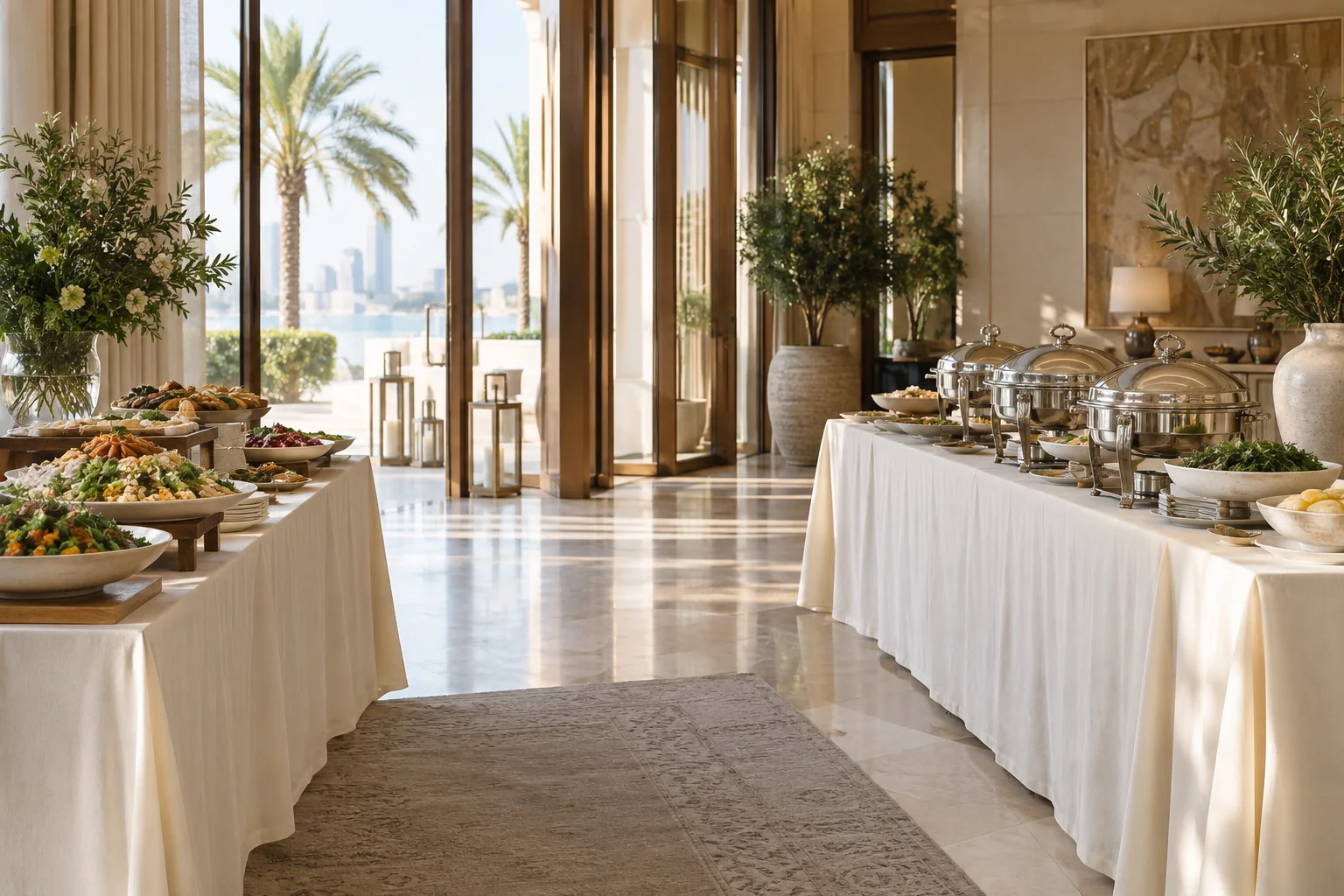
AI-generated illustration of a hosting concept.
Buffet layout planning in Dubai begins with how people will move through the room. Food variety matters, but a buffet also needs a clear beginning, enough space to make choices, a sensible exit and a way for the team to replenish without crossing every guest. A longer table alone does not solve those problems.
This guide uses an illustrative forty-person gathering at a home or private venue. It is a planning framework, not a prescribed floor plan or a venue safety standard. The caterer and property team should confirm the actual arrangement. For a service proposal, start with buffet catering.
Buffet layout planning in Dubai: map the room first
Mark the entrance, dining areas, kitchen access, doors, steps and any route that must remain clear. Include furniture as it will be positioned during the event, not as it appears in an empty-room photograph.
Think about what happens when guests stop. A queue is not only a line of moving people; it includes someone reading a label, deciding between dishes or helping a child. Put the buffet where those pauses do not block the entrance, a main passage or the route to seating.
Ask the venue or property manager to confirm any access and safety requirements that apply. Do not treat an attractive diagram as permission to obstruct a required route. If a layout only works when everyone moves perfectly, it needs more room or a different service approach.
Take photographs from the guest entrance, the proposed food station and the kitchen route. They help the caterer understand the relationship between the spaces and suggest adjustments before equipment is delivered.
Give each station a clear job
A practical buffet can be thought of as several functions: collecting a plate, choosing food, collecting drinks, finishing the plate and returning used items. These functions may share furniture, but they should not all compete at the same point.
For example, placing coffee beside the first hot dish may create a queue of people who only want a drink. Putting cutlery where guests must reach back across the food can produce awkward movement. A clearing point at the entrance can turn the welcome area into a collection of used plates.
Separate drinks where the room allows and make the path towards seating obvious. If condiments or finishing items take time to choose, consider a point beyond the main food service so guests can step aside.
The best arrangement is the one guests understand without repeated instruction. A small sign can help, but it should not have to explain an otherwise confusing route.
Decide whether one line or several points will work
A single line can be easy to understand in a compact space. Multiple pickup points can reduce concentration at one table, but require sufficient room, appropriate food distribution and a replenishment plan for each point.
Do not duplicate only the plates while leaving every guest dependent on the same narrow section for the main dish. Identify the actual bottleneck. It may be a carved item, a slow choice, a shared serving utensil or a drinks station rather than the start of the buffet.
If a chef-served element is central to the menu, ask how it will interact with the rest of the spread. Guests waiting for that item should not prevent others from collecting food that is already ready to serve.
Discuss the menu and layout together. The grazing-table versus buffet guide helps distinguish formats that may look similar in photographs but create different guest and service patterns.
A worked arrangement for forty guests
Imagine a rectangular room with the kitchen on one side and seating beyond the food area. A possible brief might use one main buffet, a separate drinks point and a discreet clearing station near the service route. Whether that works depends on actual dimensions, access and the menu.
| Area | Purpose | Detail to confirm |
|---|---|---|
| Welcome space | Let arriving guests settle | Keep it free from the first food queue |
| Main buffet | Serve the agreed savoury meal | Confirm guest approach, exit and staff access |
| Dietary handover | Deliver confirmed alternatives | Use a clear staff process rather than guesswork |
| Drinks point | Keep drink collection independent | Confirm supplies, replenishment and used-glass handling |
| Seating | Let guests eat comfortably | Check the route with a full plate |
| Clearing point | Receive used items discreetly | Keep it separate from clean food and tableware |
Before accepting the arrangement, rehearse it with the caterer or venue contact. Walk from the entrance to the buffet, then to a seat, then to the drinks point. Repeat the route as a staff member carrying a replenishment tray. If the two routes repeatedly collide, revise the plan.
This exercise is useful even for an informal villa gathering. It turns a vague room description into a service brief that can be discussed and improved.
Arrange the food in a useful sequence
Ask the chef to consider how guests will build a plate. The sequence may move from lighter items to substantial dishes and accompaniments, but the exact arrangement should reflect the menu and service equipment.
Avoid separating essential accompaniments so widely that guests have to cross the room to complete one dish. At the same time, do not overload a single small area with every sauce, garnish and utensil. The arrangement should make a complete plate easy to assemble.
Give each dish an appropriate serving utensil and confirm how replacements are managed. A spoon that disappears into a dish or a utensil used across several dishes creates practical problems the service team should anticipate.
Use readable dish identification where it helps guests make decisions. Menu names alone may not answer ingredient questions; staff need access to the confirmed information. Keep the wording clear and avoid unsupported dietary guarantees.
Treat dietary service as a process
Collect requirements before the menu is confirmed and discuss whether alternatives will appear on the main buffet or be handed to the intended guests separately. A separate dish placed somewhere on the table is not a complete service plan.
If an alternative is shared, confirm that there is enough for the people depending on it even when other guests choose it too. If it is served individually, identify who manages the handover and how the guest knows where to ask.
For allergies or other essential requirements, ask the caterer to confirm ingredients, preparation, handling and the limitations of the proposed service. Do not assume that a small distance between dishes establishes separation. The dietary requirements page is the route for a specific discussion.
The mixed-diet menu guide can help you plan a meal where alternatives feel equally considered. The buffet layout should then support that plan rather than leaving a guest to solve it while holding a plate.
Leave room for replenishment
A buffet is an active service area. Food, utensils, plates and other supplies may need replenishment or replacement during the event. Ask where those items wait and how staff reach the table.
Do not use every available surface for decoration. The team needs practical working space, and replenishment should not depend on moving flowers, gifts or guest belongings each time a dish is refreshed.
Ask the caterer how the menu will be presented and replenished under its handling plan. Putting every portion out at once is not automatically the best approach. Follow the agreed service duration and instructions rather than keeping dishes displayed simply because the event continues.
If the buffet is delivered without staff, identify the person who will carry out the handover instructions and maintain the station. The drop-off service page and service-format comparison help clarify which responsibilities stay with the host.
Separate the guest route from the working kitchen
Guests should not need to pass through the cooking workspace to reach drinks or a seat. Equally, the team should not have to carry replenishment through a tightly packed conversation area if another route is available.
In a home, explain which doors and surfaces can be used. If the kitchen connects to the garden through a narrow opening, that route may become a pressure point for both guests and staff. A different buffet position or a separate drinks location can sometimes solve it.
Consider the return journey as well as the outward one. Used plates and empty serviceware need somewhere to go. If clean trays and used items share a route, the team should agree how that is managed rather than improvising in the middle of service.
For an outdoor event, use the villa kitchen planning guide to brief the working area, access and fallback arrangements. The guest-facing buffet is only one part of the setup.
Plan for children and guests who need assistance
Think about whether everyone can comfortably reach and use the proposed service. Some guests may need a chair nearby, help carrying a plate or a staff-assisted alternative to queuing. Ask the host or guest what would be useful instead of assuming one arrangement suits everyone.
Children may need adult assistance around hot equipment and service areas. Plan their eating time and seating so that they are not moving unpredictably through the busiest part of the buffet. The children-and-adults party menu guide covers how to coordinate a mixed-age event.
Do not rely on children’s portions being a fixed fraction of adult portions. Give the caterer the age mix and the intended menu, then agree quantities and service details. For layout, the important point is where adults can help without blocking everyone else.
If a guest requires a particular access arrangement, confirm it with the venue and service team before the event. A thoughtful alternative is easier to organise in advance than in a crowded room.
Make the outdoor decision early
For a garden or terrace buffet, discuss the environment, equipment and indoor alternative with the caterer and property team. The plan should account for what happens if outdoor service becomes unsuitable, without making unsupported assumptions about the weather.
Identify who makes the decision and when the setup needs to be finalised. An indoor fallback that has no space for the buffet, guests and service route is not a practical fallback.
Avoid placing food where it competes with unrelated activities or where the team cannot manage the agreed service conditions. Follow the caterer’s recommendations about presentation and handling. Decorative appearance should not override the working requirements of the food.
If the outdoor element is mainly for atmosphere, you may decide to serve food indoors and let guests move outside afterwards. That can preserve the experience while simplifying the catering setup.
Check the complete equipment list
Ask who supplies tables, linen, serving equipment, tableware, utensils, signage, waste facilities and any supporting equipment. Confirm what the venue already provides and whether it is available for your event.
Describe equipment by its function as well as its name. “A buffet table” is not enough if the menu requires several distinct service areas. “Tableware included” should clarify what guests receive and what happens when items need replacing during service.
Use the catering quote comparison guide to identify missing scope. A proposal with fewer hire items may be perfectly suitable if the venue supplies them; it may be incomplete if nobody does.
Confirm collection and clear-down too. Guests leaving does not make the equipment disappear, and some venues have specific access windows for removal.
Final walk-through before guests arrive
Check that doors open freely, the guest route is clear, the food labels match the menu, dietary handover is understood and drinks do not block the meal. Confirm that staff can replenish and clear without moving guest furniture.
Look at the arrangement from a first-time visitor’s perspective. Can you see where to begin? Is there somewhere obvious to go with a plate? Can someone ask an ingredient question without stopping the whole line?
Send your room photographs, guest count, menu preferences and service expectations through the enquiry form. A well-planned buffet feels easy because the movement, equipment and responsibilities have been considered before the first guest picks up a plate.