By myCHEF Dubai Team|
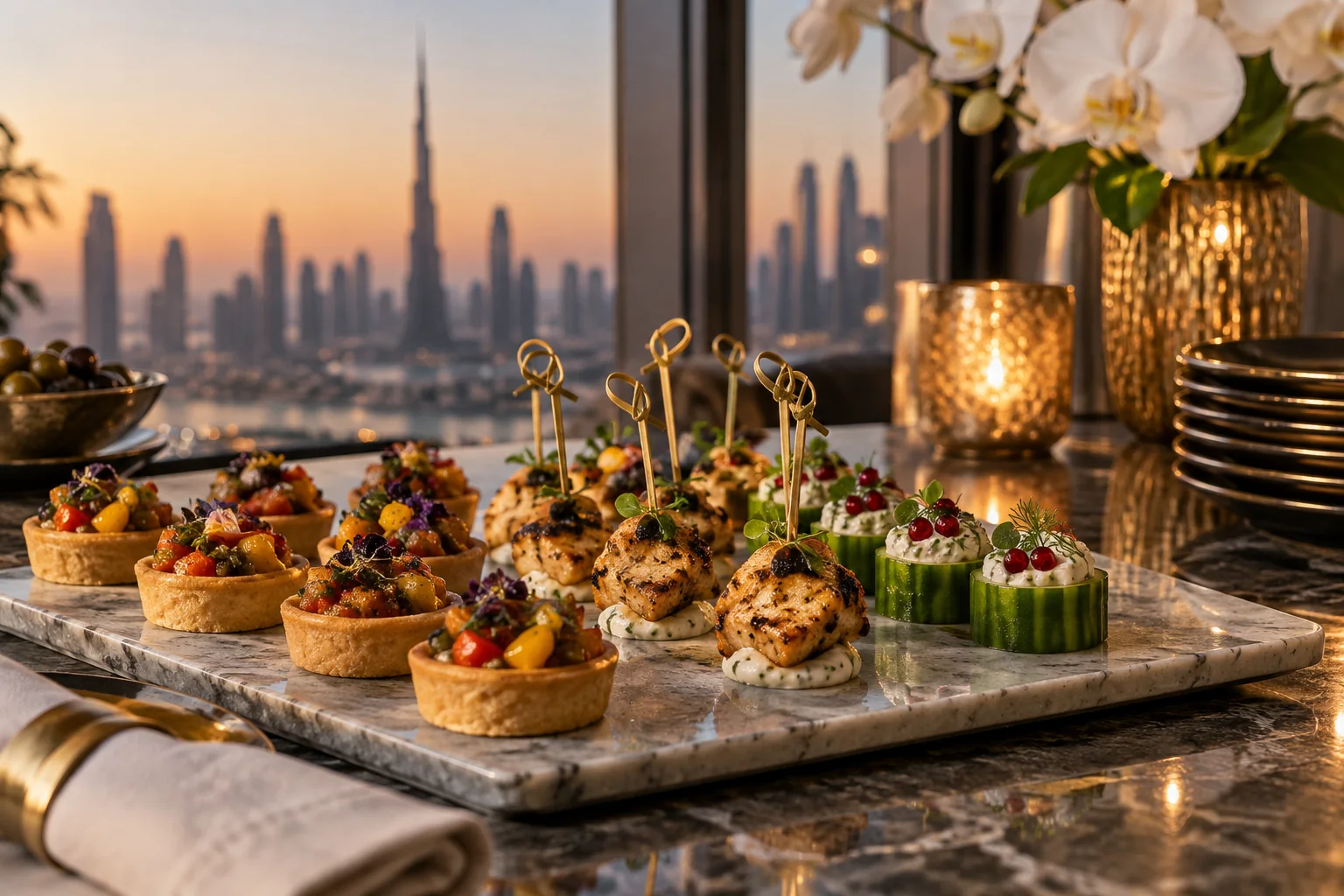
AI-generated illustration of a hosting concept.
Canapé reception planning in Dubai starts with the role of the food. Are you welcoming guests before dinner, hosting a short networking event or replacing a seated meal with a standing reception? The answer changes the quantity, menu balance, service rhythm and staffing more than an attractive photograph of a tray ever can.
This guide explains how to build a useful brief and includes worked arithmetic to discuss with your caterer. The example quantities are illustrative assumptions, not universal consumption recommendations or a myCHEF package promise. For menus and a proposal, start with canapé catering.
Canapé reception planning in Dubai: decide what the food must do
Write down the guest count, start and finish times, and whether another meal follows. Tell guests what to expect. An invitation that implies dinner creates a different expectation from one that clearly describes a brief reception before another event.
Consider the time of day and the guests’ likely circumstances. People arriving directly from work may expect a more substantial food offering than guests who have just finished lunch. A reception with speeches and a presentation also creates a different eating pattern from continuous informal conversation.
The caterer should use that context to recommend the actual menu and quantity. Avoid choosing a number of pieces first and trying to make it fit every situation. A tiny tartlet, a filled bun and a small bowl dish are not interchangeable units of a meal.
If the event needs to replace dinner, discuss whether a combination of passed bites and more substantial food would work better. The cocktail-party catering page is useful for a wider standing-event brief.
Separate piece count from menu variety
A menu listing eight canapé types does not tell you how much food each guest receives. Ask for both the number of varieties and the total quantity, with the distribution by item where it matters.
For example, a hypothetical sixty-person reception with four pieces allocated per guest contains 240 pieces. If the menu has six varieties in equal quantities, that would be forty of each. The arithmetic is straightforward, but it does not establish that four pieces is appropriate for your event. That decision depends on the purpose and the size of the items.
It also does not mean every guest will taste every variety. If you want everyone to have the opportunity to try a particular item, discuss how that affects the quantity and service approach. Otherwise, the most popular tray may disappear before it reaches the far side of the room.
Ask whether the quoted count includes dessert bites and any more substantial items. A proposal can look generous while allocating part of the total to a different stage of the event than you expected.
A worked quantity discussion
The following examples show how to interrogate a proposal, not how to select a quantity without professional advice.
| Illustrative brief | Arithmetic | Question to resolve |
|---|---|---|
| Sixty guests, four pieces each | 60 × 4 = 240 pieces | Is this only a welcome service before a full meal? |
| Forty guests, six pieces each | 40 × 6 = 240 pieces | Are the items substantial enough for the planned occasion? |
| Fifty guests, eight pieces each | 50 × 8 = 400 pieces | How are savoury, sweet and dietary portions distributed? |
| An additional ten confirmed guests | Add the agreed allocation for ten | Can the same menu and service plan accommodate the change? |
The first two examples have the same total piece count but different guest experiences. This is why a total alone is not a complete specification. Ask the caterer to explain the intended experience in ordinary language: a light welcome, a longer reception or a substantial standing meal.
If you need a margin for uncertain attendance, identify it explicitly. Keep confirmed guests, possible additions and the final ordered quantity as separate numbers until the booking deadline. That makes revisions easier to understand.
Build contrast into the menu
A good reception menu offers variation in flavour, texture and format without feeling like a collection of unrelated dishes. Consider lighter and richer items, crisp and soft textures, and the balance between vegetables, proteins and starches.
Avoid repeating the same base in every item. Several pastry-based bites may be delicious individually but feel monotonous together. Likewise, a menu of only delicate vegetables may not suit an event expected to provide a substantial meal. Ask the chef how the full sequence will feel to a guest.
Make items practical to eat while standing. Guests should understand how to pick them up and finish them without juggling cutlery or searching for somewhere to put a shell, stick or cup. If an item creates a used piece of serviceware, include its collection in the plan.
For a reception followed by dinner, consider the full menu together. The dinner-party timing guide explains how welcome food fits before a seated meal. Repeating a rich ingredient in several opening bites and the main course may be less enjoyable than giving each stage its own character.
Give dietary alternatives a complete allocation
Do not count a single vegetarian tray as a complete plan for every guest who needs an alternative. Record the actual requirements, identify suitable items with the caterer and check the quantity available to the people relying on them.
Suppose eight guests need a confirmed alternative and the agreed allocation is four pieces each. That is thirty-two pieces for those guests under that illustrative plan. If the same items are also popular with the rest of the room, ask how the team will make sure the intended guests receive their food.
The solution may involve designated service, separate preparation or a different distribution. It should not depend on those guests racing to a tray before everyone else. Avoid announcing personal dietary information to the room; a discreet, agreed identification method is better.
Discuss allergies and other essential requirements separately from preferences. The team must confirm what it can accommodate. The mixed-diet menu guide provides a broader planning framework, while the dietary requirements page is the route for a specific enquiry.
Plan service in waves
Food does not need to appear all at once. A sequence can match arrivals, conversation and any presentation, provided the chef confirms the menu and handling arrangements support it.
For a hypothetical seventy-five-minute welcome reception, you might discuss an opening wave after guests settle, a second wave during the main mingling period and a final lighter pass before moving to the next part of the event. The caterer should set the actual timing and distribution.
Tell the team about speeches, entertainment or announcements. It may be disruptive to pass trays through a room during a quiet presentation. Equally, stopping service for a long unplanned speech can compress the remaining food into a rushed finish.
Agree who gives the instruction to pause or restart. A single event lead can coordinate the room and kitchen more effectively than several people asking different servers to change the plan.
Make the whole room reachable
Passed service works only if staff can reach the guests. Consider furniture, narrow passages, crowded entrances and groups gathered around a bar or display. A beautiful tray that circulates repeatedly through the easiest part of the room may leave other guests underserved.
Ask the team how it will cover the space. In a home, one group may gather on the terrace while another remains indoors. At a corporate event, guests may cluster near a demonstration or presentation screen. Those patterns should be part of the service briefing.
A small fixed station can sometimes complement passed service, but it changes the guest flow and replenishment work. Use the buffet layout guide if the plan includes a substantial self-service element. Do not add a station without identifying who maintains it.
Keep the route from the preparation area clear. Servers need somewhere to collect fresh trays and return used items without crossing a congested guest queue. This backstage detail has a direct effect on how steadily food reaches the room.
Specify the staffing tasks
Ask for roles and service periods, not merely a headcount. Food preparation, tray passing, drinks service, clearing and coordination are different tasks. Depending on the event, one person may cover more than one role, but the proposal should make the arrangement understandable.
There is no single staffing ratio that can be responsibly applied to every reception. The room, menu, serviceware, access route and drinks format all matter. Ask the supplier to explain how the proposed team will cover the actual work.
If your venue provides staff, clarify the division between venue personnel and the caterer. Who supplies trays? Who clears glasses? Who handles waste? Who coordinates the moment service stops for a speech? A gap between two suppliers can be more disruptive than a modest menu.
The catering quote comparison guide helps you compare these responsibilities across proposals without relying only on the per-person figure.
Confirm the preparation and finishing area
Some items can arrive prepared for the agreed service; others may need finishing on site. Ask which appliances, work surfaces, refrigeration and other equipment the menu requires. A reception menu should be chosen with the venue’s real facilities in mind.
For a home event, send photographs of the kitchen and the proposed service area. For a hired venue, ask the venue contact to confirm available facilities and restrictions. Do not assume a small pantry can support the same menu as a full working kitchen.
If the reception is outdoors, discuss the environment and fallback plan before finalising the menu. The outdoor villa kitchen guide covers access, working space and the questions to resolve with the property team. Follow the caterer’s handling plan rather than extending service because a tray still looks presentable.
Manage the guest count and final changes
Agree when the final number, dietary list and menu must be confirmed. Ask what happens if attendance rises or falls after that point. The answer belongs in the booking terms and proposal, not in an assumption that every change is cost-free.
Keep a simple change log if several people are organising the event. Record the date, the requested change and the supplier’s acknowledgement. A message from a colleague is not a confirmed alteration until the person managing the booking has accepted it.
If the event duration grows, revisit the food and staffing together. Adding an extra hour may change guest expectations as well as personnel time. The original quantity should not be stretched silently over a different occasion.
What to send with your enquiry
Share the date, Dubai location, guest count, duration, whether dinner follows, room layout, kitchen facilities, dietary requirements and any speeches or entertainment. Explain how formal or relaxed the reception should feel and whether guests will mostly stand or have places to sit.
Ask for a proposal stating item varieties, quantities, service waves, staff roles, equipment, tableware, clearing and the final total. If something is optional, have it shown separately so you can make a clear decision.
Send the brief through the event enquiry page. A successful reception is one where guests can talk, move and eat comfortably because the quantity, menu and service have been planned as one experience.