
By myCHEF Dubai Team|
Choose myCHEF if you want vetted chefs for home cooking, weekly meal preparation or a catered event; choose MonChef if its written proposal better matches your menu, staffing and venue requirements. A mychef vs monchef booking comparison should help you compare the actual booking, not decide a winner from names alone. Start with the service format, then check what each proposal includes.
- For a mychef vs monchef booking comparison, compare written scope before choosing a private chef or catering service.
- myCHEF provides vetted chefs for household cooking, weekly meal preparation, dinner parties and catered events.
- Choose MonChef when its written proposal better meets your specific menu, staffing and venue requirements.
- Confirm ingredients, service staff, equipment, dietary arrangements and clear-up before accepting either proposal.
Why the booking matters more than the brand name
A recurring household cooking arrangement and a birthday dinner need different briefs. The first centres on meals, preferences and a repeatable routine. The second centres on a particular date, guest experience and service schedule.
Treat those as different purchases, even if the same number of people will eat. A single dinner or celebration belongs to private dining or catering; weekly meal preparation belongs to a recurring household service.
For more context on the provider options, the guide to MonChef alternatives is a related starting point. Use this comparison to ask both providers the same questions and assess their replies against your actual requirements.
The better booking is the proposal that explains how your meal will happen. A menu alone does not establish who will cook, serve, supply equipment or clear away.
At a glance: compare the scope, not assumed differences
The table below separates myCHEF’s stated service scope from the questions to put to MonChef. It is a booking checklist, not a claim that either provider includes every item automatically.
| Dimension | myCHEF | MonChef |
|---|---|---|
| Best for | Households and businesses seeking private chefs or catering | Choose when the written proposal best matches your specific brief |
| Service format | Home cooking, weekly meal prep, dinner parties, corporate events and large celebrations | Ask which format the proposed booking covers |
| Chef selection | Vetted chefs | Ask how the chef is selected and assessed |
| Menu planning | Confirm the proposed menu and revision process | Confirm the proposed menu and revision process |
| Staffing | Request the cooking and service responsibilities in writing | Request the cooking and service responsibilities in writing |
| Kitchen and equipment | Confirm what your kitchen must provide | Confirm what your kitchen must provide |
| Dietary requirements | Request written confirmation for each requirement | Request written confirmation for each requirement |
| Pricing model | Request a quote explaining the charging basis and exclusions | Request a quote explaining the charging basis and exclusions |
| Standout decision factor | Stated range of household and event services with vetted chefs | The specific strengths documented in the proposal |
Service fit wins before menu detail
Choose the provider that confirms the right service format. Do not compare a household cooking proposal with an event-catering proposal as though they deliver the same experience.
For recurring cooking, explain the routine you want. Specify meal preferences, cooking frequency, storage expectations and whether the chef is preparing food for later or serving it immediately. Ask who buys ingredients and how changes to the household schedule are handled.
For a dinner party, explain the occasion and the service you want around it. A chef preparing dinner does not establish whether someone will welcome guests, carry plates, replenish drinks or manage the table.
For example, an illustrative 8-guest dinner needs a brief about the evening. An illustrative 4-meal weekly plan needs a brief about repetition, portions and storage. These are planning examples, not service packages.
Best for a household routine: the proposal that explains the recurring arrangement. Best for an occasion: the proposal that explains cooking, serving and the event schedule.
Chef vetting favours myCHEF’s stated service
myCHEF’s private chef and catering service explicitly includes vetted chefs. That is a relevant starting point if you want someone cooking in your home rather than simply delivering finished food.
The next question is what that means for your booking. Ask about the proposed chef’s relevant experience, menu suitability and any information you can review before confirming. Vetting should not replace a discussion about the work you need done.
Put the equivalent questions to MonChef. Ask how the proposed chef is selected, what experience relates to your occasion and how a replacement would be handled if required.
A stated vetting process is useful; a clear match to your brief is the practical test. Do not infer qualifications, specialist dietary expertise or a particular chef assignment from a general service description.
Menu clarity is a tie until the proposals separate
Neither provider should win on menu planning merely because a sample menu looks appealing. Compare the menu proposed for your booking, including the parts that are easy to overlook.
Ask both providers to confirm:
- The dishes and course sequence.
- Whether food is plated, shared, served from a buffet or delivered ready to eat.
- Which elements are prepared at your venue.
- Whether children or guests with different preferences need separate dishes.
- How menu revisions are agreed.
- Whether substitutions require your approval.
An illustrative menu might include shared starters, a main course and dessert. That is a discussion framework, not an advertised package. The useful question is whether the chosen format suits the evening you want to host.
Both proposals should be judged against the same menu brief. Give each provider the same preferences and restrictions before comparing replies. Otherwise, the difference could come from your instructions rather than the service offered.
The clearer staffing proposal wins for hosted events
Cooking and hosting are separate responsibilities. A proposal that names the chef but leaves service unspecified does not yet explain how your guests will be looked after.
Ask who handles food preparation, plating, table service, buffet replenishment and clear-up. If drinks service matters, include that explicitly rather than assuming it belongs to the food booking.
An illustrative 20-guest celebration could involve a shared meal, a buffet or a seated dinner. Those formats create different tasks. Guest count alone does not settle which staffing arrangement fits.
Use these role labels when reviewing either proposal:
- Cooking: Who prepares and finishes the food?
- Service: Who brings food to guests or maintains the serving area?
- Equipment: Who supplies and positions the agreed items?
- Clear-up: Who clears food-service items and what is excluded?
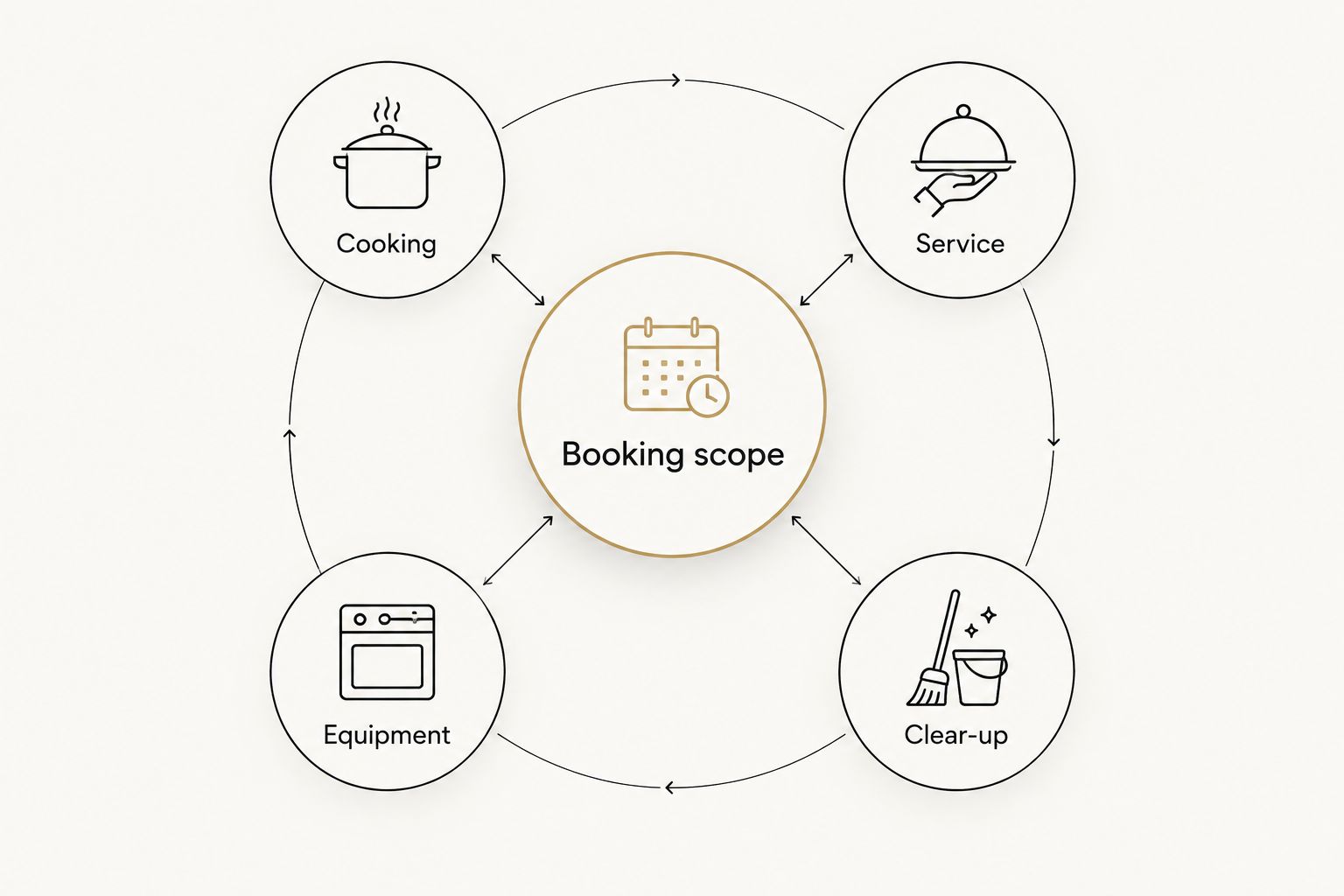
The stronger event proposal names responsibilities, not just a staffing total. For a host who wants to spend the evening with guests, that distinction matters more than an unexplained headcount.
Kitchen planning is a shared requirement, not a brand advantage
Both proposals need to work in the actual space. Before agreeing a menu, describe the kitchen and any separate serving area.
Useful details include the oven, hob, refrigeration, work surfaces and washing-up arrangements. Photographs can help explain the layout, but ask what the provider needs to assess rather than assuming pictures replace a conversation.
For a Dubai apartment or villa, also discuss building access, parking, unloading and any venue-specific permissions with the property contact. Confirm arrangements for outdoor service if you plan to eat outside. These are practical checks, not statements about a particular building’s rules.
Ask each provider which equipment comes with the booking and which items you must supply or arrange separately. Crockery, glassware, serving dishes, tables and linens should not disappear into an undefined phrase such as event setup.
Neither provider wins until the proposed menu and service fit your venue. A written equipment list makes the comparison easier and reduces assumptions on both sides.
Dietary handling wins on written confirmation
Dietary requirements need to appear in the brief before the menu is agreed. Distinguish allergies from preferences, and identify which guests need which arrangements.
Ask both providers how they will handle ingredient checks, substitutions, preparation and service. For halal requirements, specify what you expect and request confirmation for the proposed menu. Do not infer suitability from cuisine names.
For allergies, ask directly about cross-contact precautions and any limits the provider needs to explain. A dish description alone is not enough to establish suitability for an individual guest.
The better dietary proposal gives a specific answer to the requirement you supplied. A general assurance should not replace an agreed plan. If a provider cannot meet a requirement, adjust the menu or booking format before confirming rather than leaving the question unresolved.
Compare pricing models through inclusions and exclusions
Compare the charging basis as well as the total quotation. Ask whether each proposal is organised around a chef session, recurring arrangement, guest count, event scope or another stated basis. Do not assume the two bookings use the same model.
A defined scope gives you a clearer planning baseline. A flexible scope lets you alter the menu or service, but the proposal needs to explain how those changes are quoted and approved.
Request an itemised explanation covering:
- Ingredients and responsibility for shopping.
- Chef time and any additional service staff.
- Transport, access or setup arrangements.
- Equipment and tableware.
- Menu changes and guest-count changes.
- Clear-up and any separate services.
Then compare like with like. A proposal for food preparation alone should not be assessed as equivalent to one that also specifies table service and equipment.
The more useful quotation makes the boundary of the booking clear. Ask for clarification wherever an inclusion is ambiguous. Avoid accepting a proposal first and discussing essential responsibilities afterwards.
Timing and changes need one agreed record
Set out the event sequence before confirming either booking. Include venue access, preparation, guest arrival, food service and the point at which the team is expected to finish.
Ask how the provider handles changes to the menu, guest count or venue. Request the applicable payment, cancellation and rescheduling terms in writing; do not assume another provider’s terms apply.
A reply can be friendly and still leave the booking unclear. Look for answers to your actual questions rather than judging only by the speed or tone of the conversation.
Choose the proposal that leaves you with one usable record of the agreement. Keep the menu, responsibilities, schedule, exclusions and terms together so that everyone is working from the same brief.
Final verdict: choose against your own booking brief
Choose myCHEF for a defined household or event brief
myCHEF is a private chef and catering option for households and businesses seeking vetted chefs. Its stated services cover home-cooked meals, weekly meal preparation, dinner parties, corporate events and large catered celebrations.
For a household organiser, the next step is to confirm the recurring routine. For an event host, confirm the specific cooking, service and venue responsibilities. The stated service range does not make every possible inclusion automatic.
Choose MonChef when its proposal fits your priorities better
Choose MonChef if its written proposal better meets your non-negotiable requirements. A host prioritising a particular menu, staffing arrangement or venue setup should compare those commitments directly.
That is a proposal-level decision, not a claim about unverified service advantages. The same standard applies to either provider: choose the booking that answers your brief clearly.
| Dimension | Decision rule |
|---|---|
| Service fit | Choose the proposal covering your actual booking format |
| Chef selection | myCHEF states vetted chefs; compare the proposed chef match |
| Menu | Tie until you compare agreed menus |
| Staffing | Choose the clearer allocation of responsibilities |
| Kitchen and equipment | Tie until venue requirements are confirmed |
| Dietary requirements | Choose the specific written plan |
| Pricing model | Choose clear inclusions, exclusions and change rules |
| Timing and terms | Choose an agreement you can review as a whole |
FAQ
Is myCHEF better than MonChef for a Dubai booking?
Choose myCHEF or MonChef according to the written proposal for your booking. Compare service format, chef selection, menu, staffing, equipment, dietary arrangements and terms rather than assuming an overall winner.
What should I ask before booking a private chef?
Ask what the chef booking includes and what you must arrange separately. Confirm ingredients, kitchen requirements, service staff, equipment, clear-up and the proposed schedule.
Does a private chef booking include waiters?
Do not assume a private chef booking includes waiters. Ask the provider to identify who handles cooking, plating, table service and clear-up in your specific proposal.
How do I compare two catering quotations fairly?
Compare quotations against the same menu, guest count, venue and service brief. Check ingredients, staffing, equipment, transport, clear-up and exclusions before assessing the overall quotation.
Is weekly meal preparation the same as dinner-party catering?
No. Weekly meal preparation supports a recurring household routine, while dinner-party catering supports a particular occasion and service schedule.
What should I tell a chef about allergies?
Identify each allergy before the menu is agreed and ask for a specific preparation and service plan. Request information about ingredient checks, cross-contact precautions and any limits the provider needs to explain.
What details are needed for a tailored enquiry?
Send the date, location, guest count and service required. Add your preferred meal format, dietary requirements, kitchen details and any staffing or equipment needs.
Send the same brief to both providers
Before enquiring, write one brief and use it for both conversations. That small step makes the replies comparable and exposes unanswered questions without relying on assumptions.
To enquire with myCHEF, send your date, location, guest count and service required. State whether you need recurring household cooking, a private dinner or event catering, then add the menu, dietary and practical details that matter to you.