
By myCHEF Dubai Team|
Choose myCHEF if you want vetted chefs for a private dinner or catered celebration; choose Dish.ae if its written proposal better meets your event’s menu, staffing and venue requirements. A useful mychef vs dish.ae event proposal comparison judges what each supplier commits to deliver, not how appealing the menu sounds. The stronger proposal makes the host’s remaining responsibilities clear.
- A mychef vs dish.ae event proposal comparison should prioritise written scope, staffing and venue arrangements.
- myCHEF suits hosts seeking vetted chefs for private dinners and catered celebrations.
- Choose Dish.ae when its written proposal better satisfies your specific event brief.
- Compare menus, equipment, dietary handling and clear-up responsibilities before accepting either proposal.
Compare the event brief before comparing suppliers
An event proposal is an agreement about the evening, not just a selection of dishes. Food, service, equipment and access need to fit together. A menu you like does not settle who serves it, where it is finished or what happens after the guests leave.
Send both suppliers the same brief. Otherwise, you risk comparing a food-only response with a staffed event proposal and treating the difference as a supplier advantage.
For a broader shortlist, the guide to Dish.ae alternatives provides a related starting point. Keep this comparison focused on the proposals for your actual event rather than general company rankings.
Your brief should state:
- The event date, Dubai location and venue type.
- The expected guest count, including children where relevant.
- Whether guests will sit down, circulate or arrive in stages.
- The food format and any drinks-service requirements.
- Dietary requirements and allergies that need discussion.
- The kitchen, refrigeration and preparation space available.
- The responsibilities you want the supplier to take on.
A single birthday dinner or celebration is an event brief. Recurring household cooking is a different service requirement, even when the same chef provider offers both.
At a glance: compare commitments, not assumptions
Use the following table to read the proposals side by side. The questions are decision criteria, not claims that either supplier includes a particular service automatically.
| Dimension | myCHEF | Dish.ae |
|---|---|---|
| Best for | Hosts seeking vetted chefs for private dinners or catered celebrations | Hosts whose event requirements are better met by its written proposal |
| Service format | Match the proposed chef or catering service to your occasion | Check the proposed event format against the same brief |
| Menu scope | Confirm courses, portions, substitutions and presentation | Confirm courses, portions, substitutions and presentation |
| Staffing | Ask which cooking and service roles the quotation covers | Ask which cooking and service roles the quotation covers |
| Dietary requirements | Request written agreement on requirements and handling | Request written agreement on requirements and handling |
| Venue and equipment | Identify what the supplier brings and what you provide | Identify what the supplier brings and what you provide |
| Pricing model | Check the quotation’s charging basis and adjustment rules | Check the quotation’s charging basis and adjustment rules |
| Standout feature | Vetted chefs are part of the stated service | Identify the proposal commitment most relevant to your event |
| Event close | Confirm clearing, washing-up and collection responsibilities | Confirm clearing, washing-up and collection responsibilities |
Neither supplier wins an event requirement through reputation alone. A written commitment is more useful than an assumption about what a caterer normally does.
A defined service format beats a longer menu
Start with how you want guests to experience the event. A seated dinner, circulating canapés and a buffet require different arrangements. Ask each supplier to describe the proposed format in plain language.
For a seated dinner, the proposal should explain how courses reach the table and who manages service. For a standing reception, it should explain food distribution, replenishment and where guests can put used plates or glasses.
Do not use guest count as the only deciding factor. Your main question is whether you want someone to cook, someone to deliver food or a team to manage food service throughout the event.
Best for a host who wants to stay with guests
Prioritise a proposal that assigns serving, replenishment and clearing responsibilities. If those tasks remain with you, decide whether that matches the evening you want.
Best for a host comfortable managing service
A narrower scope can suit you when you deliberately want to arrange your own serving and clearing. The trade-off is personal involvement. Confirm it before accepting, rather than discovering it during the event.
Neither format is automatically better. The right format matches how much hosting work you want to keep.
Menu clarity wins over impressive dish names
Read the menu as an operating plan. Ask what arrives prepared, what is cooked or finished at the venue and how the dishes will be served.
A proposal should make substitutions understandable. Confirm whether a change to an ingredient, dish or course needs your approval. If the menu contains alternatives, establish when you must make the final selection.
Use an explicitly illustrative brief to test the detail: a seated dinner for 24 guests, with 3 courses, served over 2 hours. These are planning assumptions, not a package or a statement about either supplier’s service.
For that example, ask both suppliers:
- Does the menu describe individual plates or shared dishes?
- How will the main course reach the guests?
- Are vegetarian guests receiving an agreed alternative?
- Does dessert service include any separate birthday-cake arrangements?
- What changes if the guest count changes?
The useful answer is not simply that the menu is flexible. It explains which parts can change, who approves the change and how the revised scope is recorded.
Choose the menu you understand well enough to approve. A shorter, clearly described menu is easier to evaluate than an elaborate list with unanswered service questions.
Named responsibilities matter more than a staffing total
A headcount does not explain the work. Ask which roles the supplier proposes and what each role covers.
Cooking, carrying plates, replenishing a buffet, serving drinks and clearing tables are separate responsibilities. A proposal that names only a chef leaves the rest of the evening to be clarified.
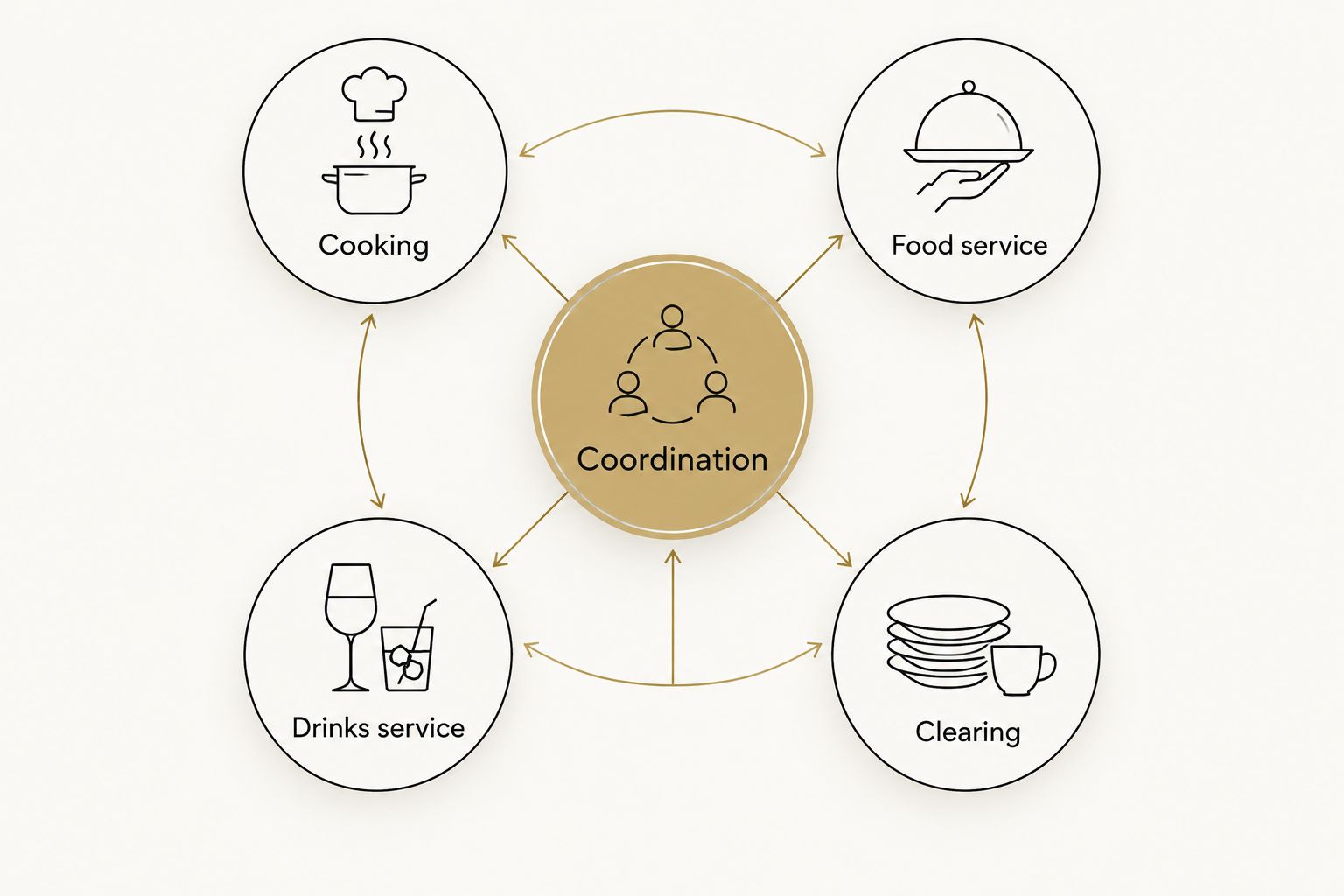
Compare both responses using the same headings:
- Cooking: preparation, finishing and plating.
- Food service: carrying dishes, replenishment and guest-facing service.
- Drinks service: responsibilities, if requested.
- Clearing: used crockery, glasses and serving equipment.
- Coordination: the person handling decisions during the event.
Vetted chefs are a stated part of the client’s service. That is a relevant reason to consider the provider for a private dinner, but it does not replace a written staffing scope for your event.
Choose the proposal that allocates the work, not the one that merely lists people. Ask for any verbal clarification to appear in the final document.
Dietary requirements need the same standard from both suppliers
Treat dietary handling as an equal requirement. Neither supplier should receive a pass because a menu contains a vegetarian dish or uses a reassuring description.
Give both suppliers the same dietary information. Distinguish preferences, religious requirements and allergies so the discussion is specific.
Ask for agreement on:
- Which dishes meet each stated requirement.
- What ingredients need clarification.
- How separate dishes will be identified during service.
- What preparation arrangements require discussion.
- Who will answer questions from guests on the day.
Do not treat a dish name as evidence of allergen suitability. Discuss the individual requirement directly and obtain the supplier’s response before approving the menu.
If plant-based choices are central to your event, the guide to vegan catering services in Dubai addresses that adjacent search. Your own proposal still needs to identify the dishes and service arrangements you are approving.
The winner on dietary handling is the supplier whose written response addresses your guests’ actual requirements. A general assurance is not a substitute for that conversation.
Venue readiness is a shared responsibility
A catering proposal needs to work in the space you have. Describe the venue accurately instead of asking the supplier to plan around an assumed kitchen or unrestricted access.
For a Dubai apartment, villa or hired venue, check the arrangements with the person responsible for the property. Ask about arrival access, unloading, lift use, preparation areas and equipment placement. These are practical questions, not universal building rules.
Send useful information to both suppliers:
- Kitchen photographs or an accurate equipment list.
- Available refrigerator and preparation space.
- The intended dining and service areas.
- Access arrangements confirmed with the venue.
- Any outdoor service area that needs discussion.
- The equipment you already have and want to use.
Then ask each supplier to separate supplier-provided equipment from host-provided equipment. Plates, cutlery, glasses, serving utensils and furniture should not sit in an undefined middle ground.
The proposal that identifies a venue constraint and offers an agreed arrangement is more useful than one that leaves the issue untouched. Resolve access and equipment questions before approving the event scope.
Compare quotation structures without building a rate card
Read the charging basis before comparing totals. Identify whether the quotation is calculated around guests, menu choices, staffing, equipment, event duration or a combination of these items.
Ask both suppliers to distinguish the agreed scope from optional additions. Do not assume food service, drinks service, crockery or collection is included simply because the proposal describes catering.
A defined scope gives you clearer approval
A clearly specified quotation helps you understand what you are accepting. Its trade-off is that changes to guests, timings or requirements need to be reviewed against that scope.
Adjustable elements need clear change rules
A proposal with separately adjustable elements lets you see where requirements differ. Its trade-off is that you need a clear method for approving changes and understanding their effect on the quotation.
Neither approach is automatically better. Choose the structure that makes the full event understandable and changes traceable.
Before accepting, ask how the supplier records amendments, confirms the final guest count and handles requested additions. Review the actual payment, cancellation and postponement terms supplied with your proposal; do not assume the two businesses use matching terms.
Clearing and collection decide how the evening ends
Ask what happens after food service finishes. Clearing tables, washing crockery, removing catering equipment and dealing with waste are different jobs.
Write down the expected condition of the kitchen and dining area. Then identify which tasks belong to the supplier, the venue or you.
Equipment collection also needs an agreed arrangement. Ask when hired or supplier-owned items leave and who is responsible for access if collection happens separately.
This is an honest limitation to consider with either proposal: an attractive menu can still leave practical work with the host. That is acceptable when you choose it deliberately, not when it remains unexplained.
A clear event close is part of the service decision. Include it in your comparison before you approve the menu.
Final verdict: choose the proposal that fits your role as host
Choose myCHEF if you want a vetted-chef-led dinner or celebration
Best for: a household or event organiser seeking vetted chefs and a service brief built around a private dinner or catered occasion. Confirm the menu, staffing, equipment and event-close responsibilities in the quotation before accepting.
Choose Dish.ae if its written proposal better answers your event brief
Best for: an organiser whose venue, service format and guest requirements are more clearly addressed by the Dish.ae proposal. Make that decision from documented commitments rather than assuming an advantage in staffing, menu breadth or event scale.
Use this scorecard to finish the comparison:
| Dimension | Winner |
|---|---|
| Service format | The proposal that matches the guest experience you want |
| Menu scope | The proposal with clear dishes, service and substitutions |
| Staffing | The proposal that assigns every required responsibility |
| Dietary handling | The proposal that addresses your specific requirements |
| Venue and equipment | The proposal with an agreed, workable arrangement |
| Quotation structure | The proposal with understandable scope and change rules |
| Event close | The proposal that defines clearing and collection |
FAQ
Is myCHEF better than Dish.ae for a private event?
Choose myCHEF when you want vetted chefs for a private dinner or catered celebration and its proposal meets your brief. Choose Dish.ae when its written scope better addresses your menu, staffing and venue requirements.
What should I compare in two catering proposals?
Compare service format, menu scope, staffing, dietary handling, equipment, quotation structure and event-close responsibilities. Give both suppliers the same brief so the comparison is meaningful.
Does a catering proposal automatically include waiters?
Do not assume waiters are included. Ask the supplier to name the service roles and record the agreed staffing in the proposal.
How do I compare catering quotations fairly?
Compare the same guest count, menu format, service responsibilities and equipment requirements. Check the charging basis and how requested changes affect the agreed quotation.
What kitchen information should I send before an event?
Send an accurate equipment list, available preparation space and refrigeration details. Add venue access information and photographs where they help the supplier plan.
How should I communicate allergies to a caterer?
Discuss each allergy directly with the supplier before approving the menu. Request a clear response about ingredients, preparation arrangements and identification during service.
Who clears the kitchen after a catered dinner?
The agreed proposal should identify who clears, washes up and removes equipment. Confirm the expected condition of the kitchen rather than relying on the word catering.
One last check: compare what you still have to do
Read each proposal once as a guest and once as the host. The guest sees the menu; the host needs to know who receives deliveries, finds missing equipment, answers dietary questions and clears the space.
Before requesting your event proposal, send the date, Dubai location, guest count and service required. Add the venue setup and the tasks you want handled. Ask for the response to separate supplier responsibilities from your own so you can choose with confidence.