By myCHEF Dubai Team|
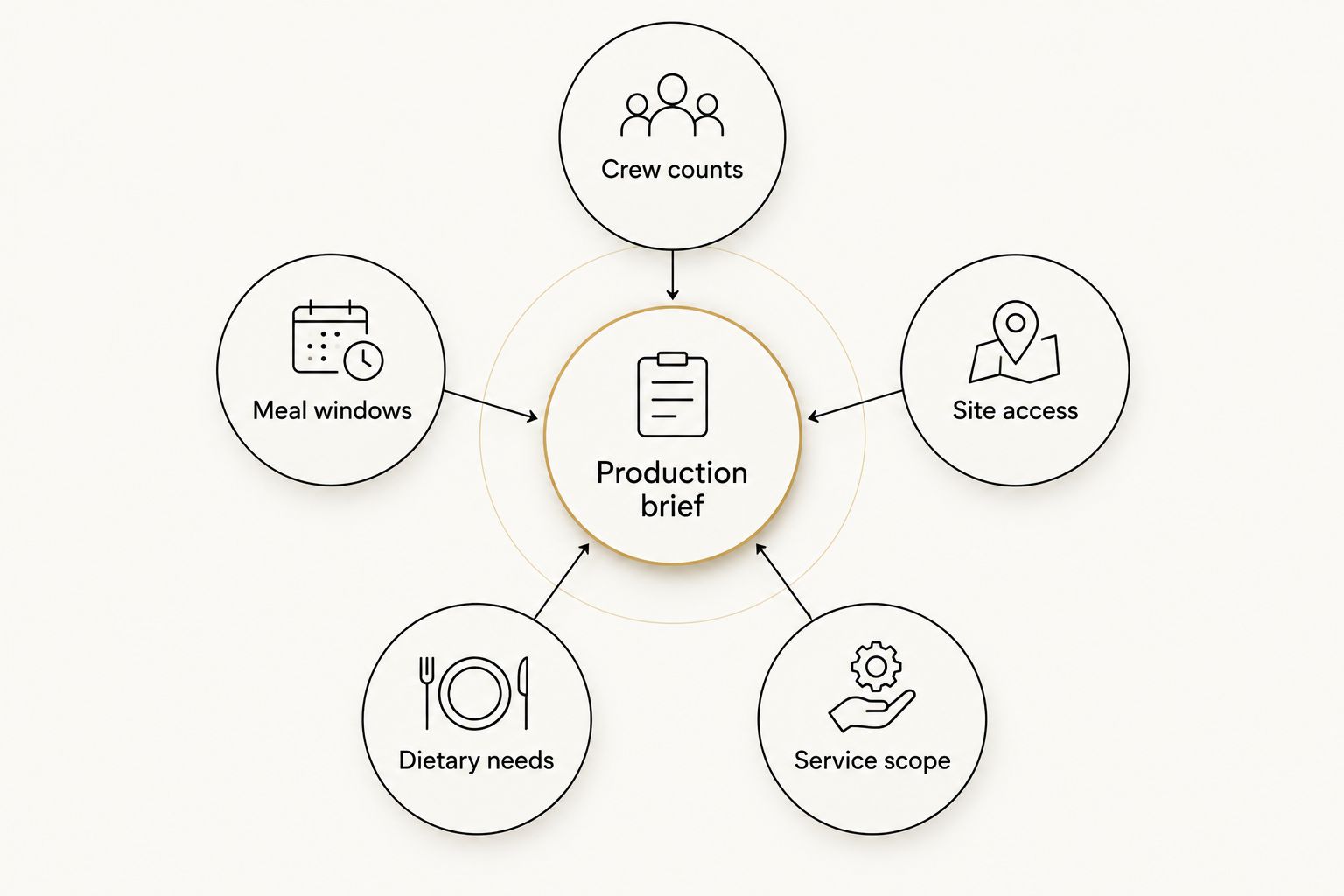
A film production catering brief in Dubai is a working document that tells a caterer who needs feeding, when meals must be ready and how food reaches the set. Build it around shift-specific headcounts, access instructions, dietary requirements and responsibility for service and clearing—not simply a menu and a total crew number.
- A film production catering brief Dubai teams can use must specify meal windows, crew counts and location access.
- Choose boxed meals for staggered breaks; choose a staffed buffet when the crew can eat together.
- myCHEF provides event catering; confirm production-specific service requirements before agreeing the scope.
- Assign one production contact to approve headcount, timing and location changes.
Why catering needs a production brief
A shooting day is not a conventional office lunch. Different departments can start at different times, move between locations and finish after the main crew meal. Your brief must explain those differences so the proposed catering matches the people actually on site.
Start with the meal format, not the cuisine. The corporate lunch catering guide provides a related starting point for workplace meals; a production brief needs additional detail about staggered breaks, set access and changing schedules.
myCHEF catering is best considered by production teams seeking event catering, with shoot-specific requirements agreed in writing. Its stated services include catering for businesses. Treat overnight coverage, multiple locations, refreshments and on-set staffing as requirements to confirm, not assumed inclusions.
The useful outcome is a brief that both production and catering can work from. It should identify what is confirmed, what remains provisional and who can authorise a change.
How to build your film production catering brief
Define the crew counts for each meal
Use your call sheet and department lists to build a meal-by-meal count. A total production headcount does not tell a caterer how many people need breakfast, lunch or a late meal. Include anyone production has agreed to feed, rather than assuming every visitor is covered.
Keep dietary counts within the overall total. If a vegetarian crew member is included in the lunch count, their meal is a substitution, not an additional portion. Record any contingency portions separately so everyone understands what has been requested.
Close this part of the brief with:
- Crew counts by meal and shift.
- Cast, client and visitor meals, where applicable.
- Dietary allocations within each meal count.
- Any separately requested contingency portions.
- A named approver for the final headcount.
Map the meal windows against the shooting schedule
Write down the eating window and the point at which catering must be ready. Delivery at the start of a break is not the same as a buffet ready to serve at that time. Allow the caterer to explain the setup their proposed format requires.
List early arrivals and late-working departments separately. If the schedule slips, agree whether meals move with it, remain at the original time or need a different service arrangement. Do not assume food can wait indefinitely; request the caterer's handling and holding plan.
Include these timing details:
- Meal windows for each shift or department.
- Required delivery, setup and service-ready times.
- Any staggered collection arrangements.
- The contact who communicates schedule changes.
- The agreed response to a delayed meal break.
Specify the site access and serving space
Give practical directions to the unloading point, not just the location pin. A delivery can reach the right building and still be at the wrong entrance. Ask the location manager to confirm vehicle access, unloading arrangements and the route to the meal area.
Describe the facilities that actually exist. A studio kitchenette, an outdoor holding area and a temporary base need different arrangements. Confirm the permitted setup with the venue or location team rather than assuming cooking, equipment connections or waste disposal are allowed.
For an enquiry to myCHEF, supply this access information alongside the menu request. It gives the catering team a clear scope to assess without implying any particular equipment or staffing is included.
Record the following:
- Site access: entrance, unloading point and access contact.
- Serving space: location, shelter and available tables.
- Facilities: confirmed power, water and kitchen access.
- Restrictions: equipment, vehicle or venue limitations.
- Waste arrangements: collection point and responsible team.
Translate dietary needs into a workable menu
Collect dietary requirements before choosing dishes. Separate allergies from preferences and religious requirements, and pass the information to the caterer accurately. A dietary label is not enough to establish whether a meal is suitable for someone with an allergy.
Ask for written confirmation of ingredients, labelling and the proposed approach to cross-contact. Where suitability cannot be confirmed, agree an alternative with the affected person before the shoot. Do not let the production assistant distributing meals make that decision at the serving table.
For the general crew menu, prioritise food that fits the eating conditions. A meal eaten standing beside a holding area needs different packaging from a seated lunch. Any example menu should remain provisional until the caterer confirms it.
Set out these menu requirements:
- Dietary needs, separated by requirement type.
- Clearly identified meal recipients where necessary.
- Ingredient and allergen information to confirm.
- Packaging suitable for the planned eating area.
- A named person to approve menu substitutions.
Choose the service format around the break pattern
Decide whether you need food delivered, meals distributed or a staffed serving point. These are different scopes. A drop-off arrangement leaves production with tasks that a staffed service can be asked to cover, including distribution, replenishment and clearing.
Choose boxed meals for staggered breaks; choose a staffed buffet for a shared meal window. Neither format fixes a poor schedule. If departments cannot reach the same serving point, explain that constraint before asking for a proposal.
Use a shared document to map the format yourself first. Then ask the caterer to refine the plan around the actual location and service requirements, rather than expecting them to infer the shooting schedule.
Confirm these service decisions:
- Whether meals are boxed or served from shared dishes.
- Whether production or catering distributes the food.
- Which staffing tasks the proposal must cover.
- Whether refreshments are separate from main meals.
- How late arrivals receive their allocated meals.
Compare the scope before comparing quotations
Send the same brief to every caterer you approach. Otherwise, a delivered-meal proposal and a staffed-service proposal are not comparable. A menu description alone does not establish who brings equipment, serves meals or removes waste.
Ask for inclusions and exclusions against your brief. Headcount, menu complexity, service duration, staffing, access, equipment and separate deliveries are useful points to discuss when assessing the quotation. Request current terms directly; do not turn a bespoke production quote into a standard rate.
Check the boundary between catering and production responsibilities. If production supplies tables or handles clearing, put that agreement in writing so it does not become an on-set assumption.
Compare these scope items:
- Meals and refreshments included in the proposal.
- Delivery, setup and collection responsibilities.
- Staffing tasks and agreed coverage.
- Equipment, tableware and consumables.
- Exclusions and the process for approving changes.
Issue a final brief and control revisions
Keep one approved document rather than separate instructions across messages. Give it a version name and record the latest headcount, schedule and site details. A clear revision log helps everyone distinguish an agreed change from a request still awaiting confirmation.
For example, a document labelled Production catering brief — 2026 shoot — approved version identifies its purpose without changing the operational details. Share the relevant extract of the call sheet, plus direct contact information for the production lead and access contact.
Arrange a final read-through of unresolved points. The caterer should confirm what has been accepted, while production confirms the facilities and access it controls.
Before issuing the brief:
- Name the person authorised to approve changes.
- Mark confirmed details and provisional items clearly.
- Record the agreed headcount confirmation deadline.
- Confirm delivery and service contacts.
- Ask both sides to acknowledge the final scope.
Which catering format fits your shoot?
Choose the format by how the crew takes its break. The options below describe planning choices, not a list of confirmed myCHEF packages. Ask which arrangements can be provided for your date and location.
| Option | Best for | Main advantage | Key limitation |
|---|---|---|---|
| Boxed meals | Staggered breaks or separated departments | Allocates individual meals without a shared buffet | Production must agree distribution and dietary identification |
| Drop-off buffet | A shared meal window with production handling service | Lets the crew choose from shared dishes | Setup, replenishment and clearing need assigned owners |
| Staffed buffet | A shared break where production wants serving support | Puts agreed service tasks with the catering team | Requires suitable space and a defined staffing scope |
| Separate meal deliveries | Early and late shifts with distinct meal windows | Matches delivery planning to different groups | Adds access coordination and separate handovers |
| Refreshment station | Snacks and drinks between main meals | Gives refreshments a defined location | Does not replace a complete meal plan |
What should a sample meal brief contain?
Use the following as an illustrative planning example, not a completed event, package or recommended portion allowance. Its purpose is to show how counts, timing and responsibilities fit together.
Illustrative scenario: a studio shoot has 40 crew members and 8 cast members allocated lunch. Within that total of 48 meals, 6 are vegetarian substitutions. A separate late shift needs 12 evening meals; those meals are recorded against that shift rather than added vaguely to the lunch order.
| Brief field | Illustrative entry |
|---|---|
| Lunch count | 48 meals, including 6 vegetarian substitutions |
| Lunch window | 13:00–14:00; serving-ready time to be agreed |
| Evening count | 12 meals for the late shift |
| Service format | Boxed lunch requested; distribution responsibility to be confirmed |
| Access | Production to supply the approved unloading point and access contact |
| Dietary confirmation | Caterer to confirm suitability before menu approval |
| Change control | Named production lead to approve count and timing revisions |
Notice what the example does not assume. It does not treat delivery as service, promise an allergy-safe meal or imply that equipment is included. Those points remain explicit questions until the proposed scope answers them.
Common mistakes production teams make
Ordering from the total call-sheet count
The full crew number is not automatically the count for every meal. Match each meal to the people present and entitled to receive it. Keep contingency portions visible rather than hiding them inside the total.
Giving a meal time without a ready-to-serve time
A caterer needs to know whether the stated time means arrival, setup completion or the start of eating. Specify each relevant handover. Then agree how production communicates a schedule change.
Leaving refreshments outside the brief
Main meals and between-meal refreshments are separate requirements. State who supplies drinks, snacks, cups and replenishment if you need them. Do not assume a lunch order covers the whole shooting day.
Treating dietary meals as an informal request
A message saying that some crew members have allergies does not identify suitable food or recipients. Collect clear requirements, seek confirmation and agree distribution. Protect personal information by sharing only what the catering process needs.
Changing location without revisiting logistics
A menu approved for a studio does not settle delivery to another site. Reconfirm unloading, facilities, serving space and collection whenever the location changes. Keep catering informed through the named production contact.
FAQ
What should a film production catering brief in Dubai include?
Include meal-by-meal headcounts, service-ready times, location access, dietary requirements and responsibility for serving and clearing. Add named contacts and a written process for approving schedule or headcount changes.
Are boxed meals better than a buffet for a film crew?
Boxed meals suit staggered breaks, while a buffet suits a crew eating together. Choose around the break pattern and serving space, then agree who distributes meals or manages the buffet.
How do I count catering meals for different production shifts?
Count each meal separately against the people present for that shift. Include dietary substitutions within the relevant total and list any contingency portions separately.
Can I request catering for an overnight shoot?
You can include overnight meals and service requirements in the enquiry, but the caterer must confirm the requested coverage. Specify the meal window, location access and whether you need delivery only or staffed service.
What information does a caterer need about the filming location?
Provide the unloading point, access contact, serving area and confirmed facilities. Explain any venue restrictions and identify who handles tables, waste and collection.
How should I brief a caterer about crew allergies?
State the requirements clearly and request written confirmation of ingredients and the proposed approach to cross-contact. Agree an alternative if suitability cannot be confirmed, and identify how the correct meal reaches its recipient.
What affects a film production catering quotation?
The scope includes headcount, menu, staffing, service duration, equipment, access and delivery arrangements. Compare written inclusions and exclusions against the same brief rather than comparing menu descriptions alone.
Related planning guides
Send the shooting-day brief, not just the menu request
The most useful final check is responsibility: who receives the delivery, who distributes the meals and who tells catering that the schedule has changed? Answer those questions before the shoot, not at the meal break.
For a tailored myCHEF enquiry, send the date, Dubai location, headcount for each meal and service required. Include shift timings, dietary requirements and access details so the proposed catering scope can be assessed against your production day.